
.jpg?h=446&w=792&mode=crop&scale=canvas&format=webp&quality=90&autorotate=true)
Mongolian Bow
Archery in Mongolia has a long and illustrious history. Folk legends tell of Erekhe Mergen, the great archer who saved the people from a drought by shooting down six suns. And when the legendary mother of the Mongolian nation wanted to instill the idea of unity in her feudal sons, she sat them down before her, gave each of them an arrow, and told them to break them. Of course, they could easily do so. Then she gave each of them six arrows and told them to break them all together. None of them could. Thus, the Mongolian people first learned about strength through unity.
Before the Mongol people entered history, the steppe countries of Asia included the Asiatic Huns and the Khitan, who ruled northern China in the 11th century and gave China one of the names by which Westerners later knew it: Cathay.
This is how the Chinese historian Sima Qian described the Huns: "The Huns had no written language: they governed themselves solely on the basis of the spoken word. Small children could ride a sheep and draw a bow to shoot small birds and rats. As they grew up, they shot foxes and hares and ate them. Their warriors were powerful archers, and all were armored cavalrymen. Their habit in peace was to follow their flocks, and so archery and hunting were part of their way of life. When war threatened, they practiced battles and attacks so they could invade or launch unexpected attacks. This was part of their nature." One can see that the Huns' way of life later became very similar to that of the Mongol nation.
In the states of Liao and Mongol in the 10th to 11th centuries, the ancestors of the Mongols played a game called "Shooting the Willow" to demonstrate our archery skills. This is how the game was described in the official history of the Khitan Liao Dynasty: "Two rows of willow branches were laid in the ground of a polo field. The archers, according to rank, chose their own branch and marked it with a piece of cloth; then they carved away the bark of the branch a few inches above the ground, allowing the white wood to show through. Led by a galloping horseman, the others followed at full gallop, shooting an unbraked arrow with a horizontal blade for an arrowhead. An archer who could cut through the willow branch and catch the cut end at full gallop received top marks. Second place went to the one who could cut the willow branch but not catch it. Those who could hit the carved part but didn't cut it, or those who missed it altogether, lost. When they shot, people beat drums to encourage them."
From the time of Chinggis Khan and the Mongolian nation itself, there are many accounts of great feats in archery. In the "Blue History," there is a story of Chuu Mergen, who shot from a distance of about 130 meters on horseback.
equipment
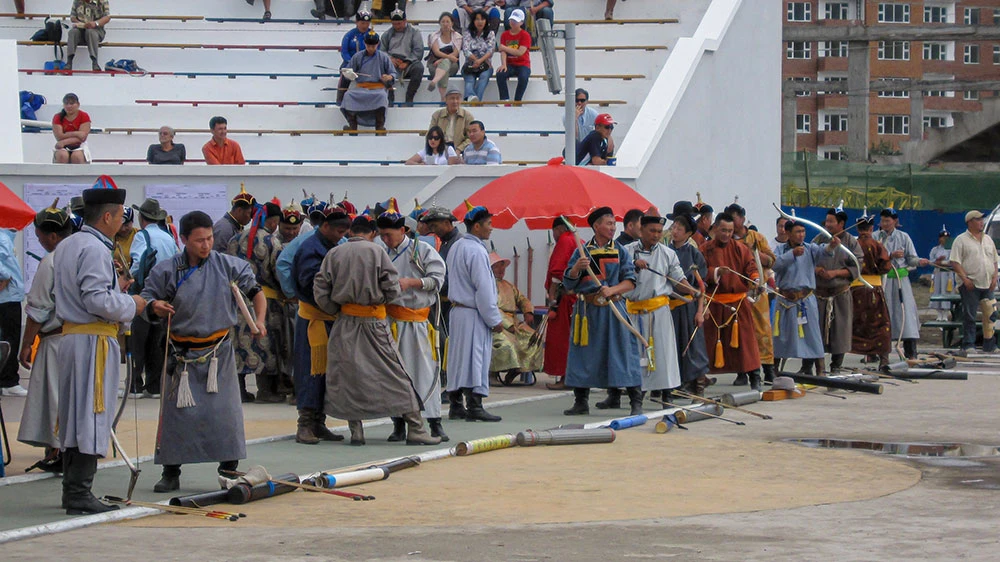
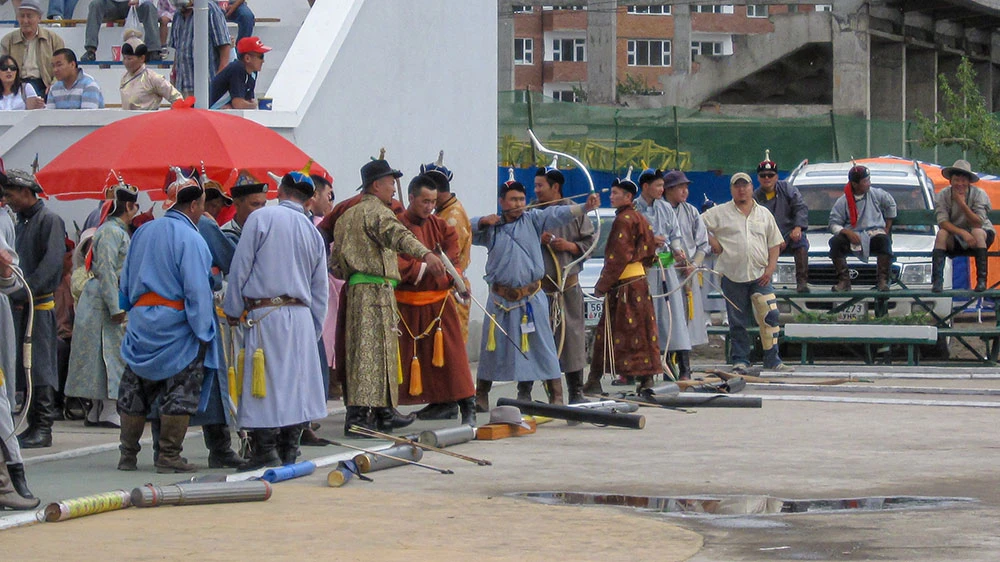
Examples of equipment used at modern Mongolian archery festivals. During these festivals, traditional compound bows are used to shoot blunt arrows at a wall or target made of rows of small woven cylinders. The bow has double nocks, birch bark on the back, painted decoration, and shagreen on each side of the handle. The arrows have birch shafts; four-feather fletchings (vulture feathers); red paint between the feathers and green stingray skin over the nocks and adjacent shafts; slightly bulbous nocks (painted red inside); and walrus ivory tips. The target cylinder is made of woven rawhide. The bow is 172.2 cm long, 4.1 cm wide at the center, and 1.5 cm thick at the center. The arrows are 95.8 cm long and 1.0 cm in diameter. The tips are 4.5 cm long. The target is 8 cm x 8 cm.
The bow
A composite bow, by definition, consists of several layers. We know the birch frame and the horn/bone layer. On top of that, there's a layer of specially prepared birch bark, which is designed to protect against moisture penetration. Added to this is another layer of sinew taken from deer, elk, or other wild animals. Domesticated tendons can also be used, but the Mongolians believe that tendons from wild animals such as deer, elk, and mountain sheep are the strongest and best. Of course, the bow must be glued together. The preferred and traditional substance used to impregnate both leather and its loops is fish glue. In fact, fish glue has proven highly moisture-resistant for millennia. Furthermore, it's durable and lasts longer than modern epoxy resins, which are prone to molecular fatigue. Fish glue is primarily available in all Siberian waters where fish live, including the largest of all, Lake Baikal.
How is isinglass made? The process that produces the highest quality involves taking swim bladders from freshwater fish, placing them in hot water to extract the protein, and then boiling the resulting broth for an extended period. If sufficient swim bladders cannot be obtained, it is also possible to produce hide glue by boiling animal skins. However, this latter method results in an inferior glue because it absorbs moisture, whereas ichthyic air bladder glue is highly moisture-resistant.
Although all the materials needed to build the Mongolian bow are found in the immediate natural environment, the entire production process is very complex. It takes a long time to build a bow that meets the requirements of the ancient Mongols. We can also assume that selecting the best wood material for the frame requires knowledge and experience.
The usual process for making a traditional Mongolian bow is as follows: The wooden frame is cured, and the horns and/or bones to be used are boiled until soft. This allows the various parts to be fitted together with great precision. As we understand, high-quality Mongolian bowmaking is certainly an impressive craft. First, the tendons must be dried. Afterward, they are crushed until they form a mass of loose fibers. Next, this mass is mixed with fish glue to form a firm but not rigid layer. It is important to apply the correct thickness and quantity of tendons. This is done in a two-step process with several days in between. Too little will weaken the bow, too much would make it stiff. When the tendon layer is finished, it can be as thick as a human finger before drying. Tendons have a special quality: unlike other materials, their strength increases when subjected to stretching or impact. This form of elasticity is a property that arises from the molecular structure of the tendon protein (collagen) and can be considered further impressive proof of the innate superiority of natural solutions and materials. When used in a Mongolian composite bow, this causes the tendon layer at the front to contract in a fraction of a second as the horn plates at the front snap back to their former shape, further accelerating the shot as the arrow is propelled forward.
Fish glue was applied at each stage to secure all the parts. For the horns and wooden parts, the sides to be glued together were first grafted together with a special toothed tool to ensure the strongest possible bond.
The final step is usually the application of the protective birch bark layers, which are also softened to ensure a proper fit before being glued to the finished bow. Once the birch bark layer has been added to the composite construction, the entire bow is tightly wrapped in rope and molded into a form where it is allowed to dry and cure at room temperature for a year or more. This ensures that the bow will be extremely strong and will retain its shape and speed even after many years of frequent shooting.
A Mongolian bow is stored in its own leather bag to protect the bow when not in use.
The arrow
Birch is a typical material for arrows. The typical length of an arrow is between 80 and 100 cm, and the shaft diameter is about 1 cm.
For fletching, crane tail feathers are preferred, but tail feathers from any bird are acceptable. Feathers taken from the wings are said to fly less evenly through the air, so if the choice is made, tail feathers are used. The Mongols characteristically pay attention to the smallest details; the placement of the fletchings in relation to their size and the part of the bird from which they come is of great importance for correct rotation and good balance in the air. Consequently, these factors are carefully considered when making arrows according to the Old Mongolian standard.
Arrowheads can be anything from broad metal blades for big game (or in war) to bone and wooden points used for hunting birds and small animals. The high impact of this bow ensures that a bone point will be fatal if it strikes the body of a smaller animal or a bird. In addition to these types of arrows, whistle arrows are useful during hunting, as the effect of an arrow whistling high above the ground often causes animals to stop and be curious about what is in the air. This gives the hunter time to release a second arrow, this time with a broadhead, to kill the animal. These whistle arrows are made by inserting a bone arrowhead into which air channels have been created. When fired, such arrowheads make a very audible sound in the air.
The tendon
No bow, no matter how powerful, can be shot without a string. Traditional Mongolian bowstrings are made from animal hide. First, every trace of fat is removed. Then, the hide is stretched and twisted. After this treatment, it will not stretch but remain taut. Although the hide of many fur-bearing animals can be used, horse hide is often preferred, as this material is said to remain supple in the exceptionally low winter temperatures of Siberia and Central Asia. It is also possible to use animal intestines as string material, but such strings are not water-resistant and therefore only suitable for use in dry and hot weather.
Silk and cotton, as well as blends thereof, can also be used. Modern archers generally use Dacron and other man-made materials, which require high technology to produce and may therefore be impossible for the archer to produce themselves.
To draw the bow, the archer sits and pushes against the bow with both feet. The limbs are bent and the string is tied. Another technique involves standing upright and bending under one leg while the other leg holds the outer end. On horseback, the Mongolian archer drew the bow by placing one end of the bow between his foot and the stirrup while pressing against the bow with his arms.
Mongolian archery competition
Archery competitions were among the traditional pastimes of the Mongols at the khan's court and in nomadic camps. Archery survived, although during Manchurian rule in Mongolia most of them were officially banned because of their military implications. Despite all attempts by the Manchurian invaders to uproot the country's ancient archery tradition, it survived and thus expressed its vitality.
With the establishment of an independent Mongolia in 1911, it took only a few years for archery to regain its massive popularity, to the delight of its sincere admirers.
The determined efforts of the authorities were a key factor here. For example, one of the documents issued by the Ministry of War of Autonomous Mongolia states that all aimags (provinces) should send 336 men annually to the capital, Urga (then Ulaanbaatar), to train at the archery school.
The Russian ethnographer IM Maisky attended the school's archery competitions during these years.
"An archery festival is truly beautiful—hundreds of white gers and multicolored, embroidered tents spread across a vast meadow at the foot of the Bogd Mountains. Visiting archers lived there," he said.
The competitions begin every morning. There are special officials who keep score sheets, which enhance the fame and prestige of aimags and khoshuuds. Targets are set up—short wooden tubes with a small ball inside. They are placed one on top of the other, forming a kind of pyramid. Hitting the target means hitting a tube from the pyramid with an arrow. Even better is hitting a ball from a tube.
Today, the rules of the Naadam team and the individual archery competitions remain almost the same.
Teams of twelve archers line up on the shooting line and each shoot four arrows at targets, which are leather cylinders installed in the ground. The shooting distance is 75 meters for men and 60 meters for women. For those under 18, the distance is three to four meters per year.
Thirty-three hits entitle a team to participate in the next round, where the targets are arranged in a more complex arrangement. The winning team is the one with the highest score.
The Naadam tournament is initiated by an archer born in the year of the Tiger—a symbol of strength and accuracy.
The arrows used are picked up by people born in the year of the mouse, a small animal considered diligent and industrious. Someone born in the year of the dragon, the symbol of eloquence, always begins by singing a song, a hymn, the magtaal, in honor of the archers. Participants in the competition are usually given the title "mergen," which means "sharpshooter."
Depending on the number of victories and other achievements, this title is supplemented by "young and improving sniper," "hardworking sniper," "amazing sniper," etc. The title of "National Sniper" is awarded to a winner in the individual ranking of the national competition known as "Naadam."
Naadam
Naadam is a traditional festival in Mongolia. The festival is also known locally as "eriin gurvan naadam" (эрийн гурван наадам), "the three men's games." The games include Mongolian wrestling, horse racing, and archery, and take place throughout the country in midsummer. Women have begun participating in archery, and girls in the horse racing games, but not in Mongolian wrestling.
In the first round of archery, 20 arrows are fired at a four-meter-long and 48-cm-high wall made up of four stacked rows of baskets ( khana ). In the second round, 20 arrows are fired at two rows of a total of 30 stacked baskets ( khasaa ). The distance from the target is 75 meters for male competitors and 60 meters for women.

.png?h=64&w=200&mode=max&scale=canvas&format=webp&quality=90&autorotate=true)
.jpg?h=165&w=248&mode=crop&scale=canvas&format=webp&quality=90&autorotate=true)
.jpg?h=165&w=248&mode=crop&scale=canvas&format=webp&quality=90&autorotate=true)
.jpg?h=165&w=248&mode=crop&scale=canvas&format=webp&quality=90&autorotate=true)
.jpg?h=165&w=248&mode=crop&scale=canvas&format=webp&quality=90&autorotate=true)
.jpg?h=165&w=248&mode=crop&scale=canvas&format=webp&quality=90&autorotate=true)
.jpg?h=165&w=248&mode=crop&scale=canvas&format=webp&quality=90&autorotate=true)


.png)